
What Is LoRaWAN?
LoRa IoT or LoRaWAN IoT represents the future for smart buildings. Until recently, the building IoT market has been dominated by wired sensors using Modbus and BACnet protocols. In recent years, different wireless communication technologies such as Zigbee, Z-Wave and Bluetooth have entered the market.
Why LoRaWAN for Commercial Buildings?
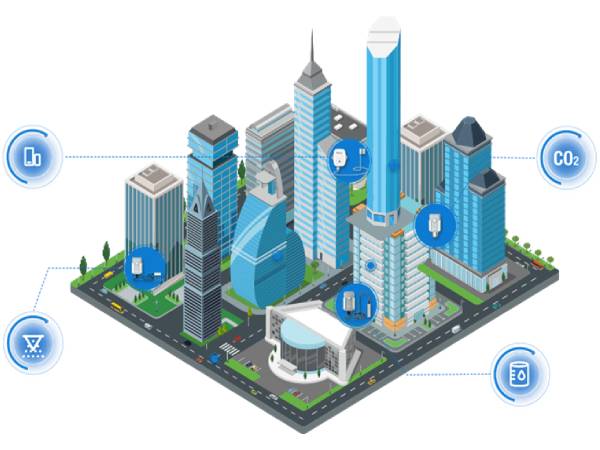
Despite the hype behind them, the short range, security risks and hard-to-configure network architecture of technologies like Zigbee and Z-Wave make them disadvantageous for the complex nature of commercial buildings. LoRaWAN is a non-cellular wireless communication protocol built for long-range communication, covering both the communication protocol and the system design for LoRa IoT networks. The LoRaWAN technology stack is a suitable option for connected buildings and cities because of its long signal range and low power requirements.
LoRaWAN Brings Different Advantages to the Market
- ➤ Ultra-Low Energy Consumption: compared to other data transmission protocols, LoRaWAN requires little power, preserving the battery life of devices.
- ➤ Range: the wider the coverage, the better and cheaper the IoT infrastructure. Depending on conditions, LoRaWAN signals can reach 10 to 15 kilometres in urban areas, and around 1 kilometre inside buildings.
- ➤ Cost Efficiency: LoRaWAN is comparatively easy to deploy within IoT infrastructure. Licence-free frequencies and low-cost base stations make it economically viable, alongside devices that run for years on the same battery and reduce site visit costs for maintenance.
- ➤ Open Standard: as an open protocol backed by the LoRa Alliance, LoRaWAN benefits from wide community best practices rather than being locked to a single vendor.
- ➤ Bi-Directional Communication: LoRaWAN-enabled sensors can both transmit and receive data, so equipment can deliver status messages even from remote locations.
- ➤ Good Building Penetration: radio waves pass through obstacles to reach sensors indoors, such as those placed in elevators, basements or underground parking garages.
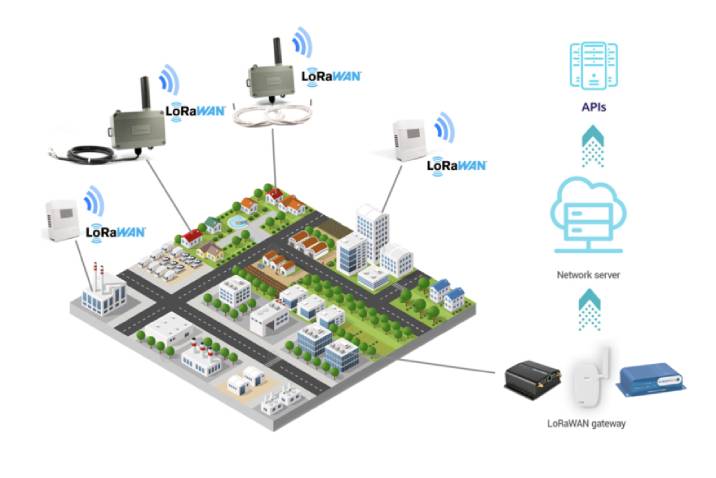
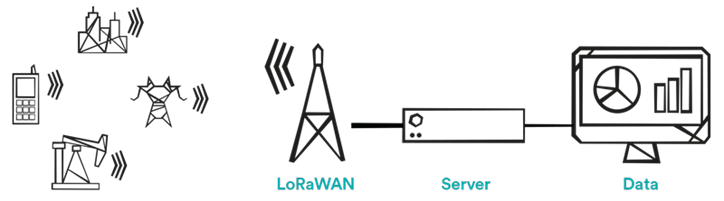
A typical LoRaWAN network uses a simple architecture where base stations connect to the internet through an available backhaul and manage bidirectional data flow between LoRa sensors and the centralized network server.
LoRaWAN vs. WiFi, Bluetooth or Zigbee
The growing importance of IoT, combined with high demand for application-relevant solutions, has brought several competing technologies to market. Comparing them directly is not straightforward, since each has a legitimate use case, and the right choice depends on the specific application.
WiFi and Bluetooth are commonly used in the smart home consumer sector to control or read data such as lighting, shading and room temperature, largely because that infrastructure already exists and meets typical homeowner needs. Local area networks, however, rarely meet the needs of commercial applications: they are designed to manage large quantities of data over a short range and are comparatively cost-intensive, even though smart buildings typically generate very little data traffic. Roughly 99.9% of LPWAN devices consume fewer than 150 kilobytes of data a month according to 3GPP (the 3rd Generation Partnership Project, an international cooperation of standards bodies for mobile communications). Data volume, energy consumption and range are directly related to one another.
LoRaWAN in Buildings
In building automation, and particularly in smart buildings, data transparency plays a central role in operating buildings as energy-efficiently as possible. LoRaWAN was developed for the requirements of the Internet of Things and offers strong wireless range with excellent building penetration. It typically takes only one gateway to fully cover an entire premises, and even basements do not pose a problem for LoRa wireless networks. Since IoT sensors and actuators use very little data, a large number of sensors can communicate with the network server through a single gateway, which is what makes LoRa wireless sensor deployments so cost-effective: they do not require multiple gateways or repeaters.
Low-power data transmission also allows energy-efficient operation of LoRa sensors and actuators using batteries, with a battery lifetime of up to 15 years not uncommon in this case. This reduces long-term maintenance work for facility management to a minimum and allows retrofit projects to be implemented quickly in existing buildings, since no cabling needs to be installed after the fact.
For integration into an existing building automation system, some LoRa gateways come equipped with standardized building automation interfaces such as Modbus, so collected data from LoRa end devices can be passed directly to the building automation system. This communication works bidirectionally and enables straightforward, efficient integration into the building automation system.
Why Choose ME Integra for LoRaWAN in the UAE
- ➤ 40+ OEM partners - access to a range of LoRaWAN sensors, gateways and network servers.
- ➤ 200+ completed projects across the UAE, including large sites covered by a single gateway.
- ➤ Modbus and BMS integration handled properly - LoRaWAN data connected into your existing building automation platform.
- ➤ Single point of contact for supply, installation and after-sales support.